Protected Forever Takes Boots on the Ground: A Day with the Stew Crew
Somewhere in the stewardship team’s files are maps of Huidekoper Ranch going back to 1997, the year it was first protected. This summer, Cami and Kyle went back to add another chapter.
Every conservation easement the Jackson Hole Land Trust holds is a promise: This land stays protected through every sale, every inheritance, and every change in ownership, forever. But an easement isn’t something you sign and file away. Forever can’t be upheld from a desk. It takes boots on the ground.
That’s where our stewardship team comes in, known around the office as the stew crew. Two year-round land stewards, with more than 23 years of combined experience, are joined each summer by two stewardship associates. Together, they aim to visit each of our 300+ conservation easements across Jackson Hole, Park County, the Green River Valley, and the Wind River Valley. Every easement, every year.
That’s more than 66,000 acres across Northwest Wyoming, or 100 square miles. That is a lot of ground to cover for just four people in just six months.
One afternoon this summer, I (Sengen Meyer, communications manager) happily traded my desk chair for a seat in the stewardship truck. Around 4 pm, I piled in with Cami, stewardship associate, and Kyle, land steward and landowner liaison. Fifteen minutes later, we were on Teton Pass at Huidekoper Ranch.
The drive was short. The preparation was not.
Every monitoring visit starts long before the truck leaves the office. Since the beginning of the year, the team had been laying the groundwork for all 300+ easements: reviewing each property’s history and our relationship with its landowner, trading calls and emails to set dates, and reading everything from baseline documents to last year’s photo point maps. By the time we pulled up to Huidekoper, Cami and Kyle knew exactly what to look for and had an aerial map of the ranch loaded on a tablet.
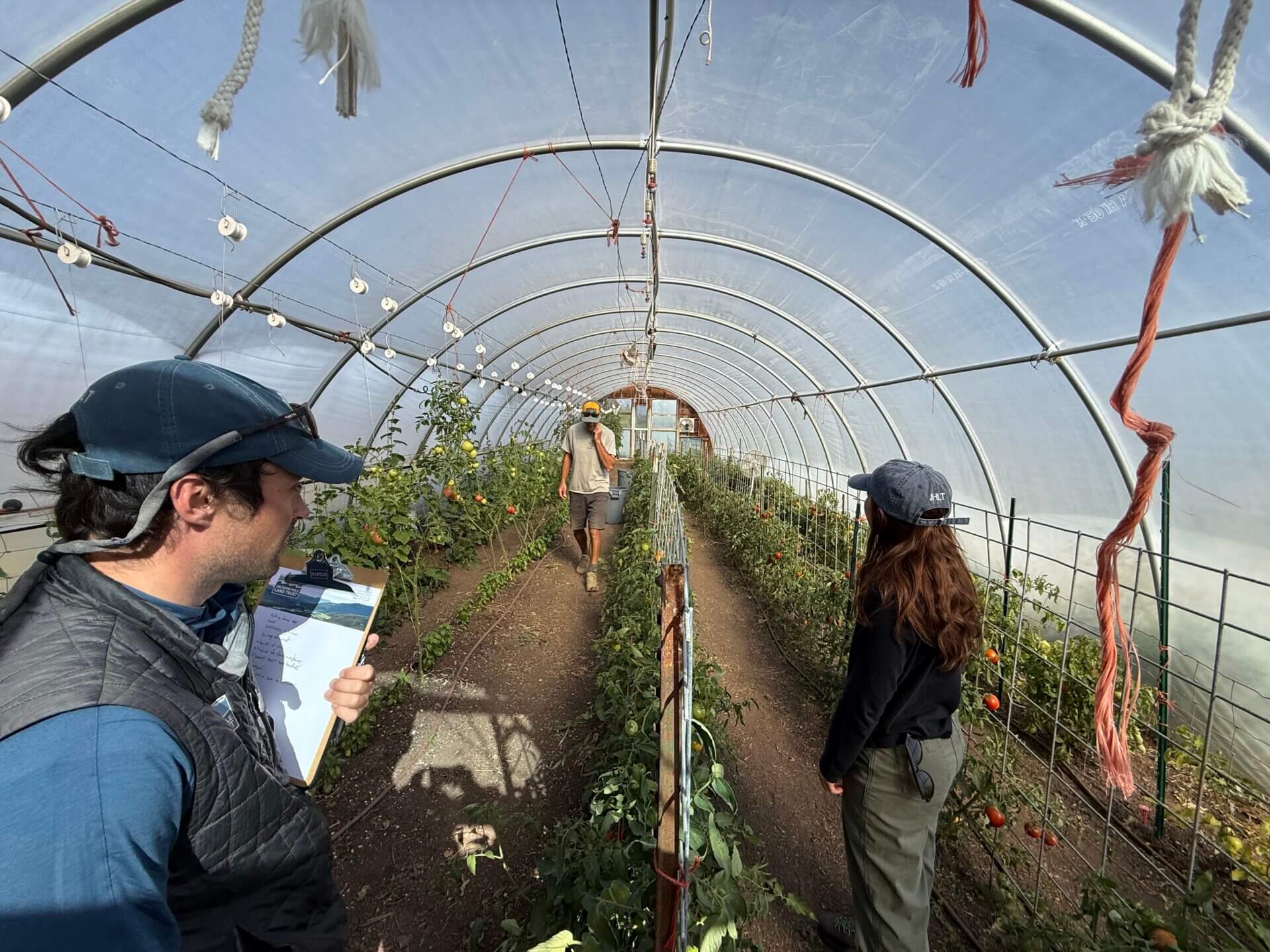
Landowner Brent Tyc met us out front. If you’ve ever ordered the caprese salad at Calico, you’ve likely tasted his work: the ranch grows the red, yellow, orange, and purple tomatoes that make the dish so colorful. Huidekoper also boards horses and grows hay.
To an onlooker, a monitoring visit looks like a walk with a neighbor. Up close, it’s much more, and it follows two tracks: documentation and conversation.
Documentation: The team identifies sites of interest in advance. At each one, they take GPS-tagged photos and record the azimuth, the compass direction the camera faced, so whoever comes next year can stand in the same spot, look the same way, and see what’s changed. Conservation easements often limit where structures such as houses, barns, and even fences can be built, so much of the stew crew’s documentation work involves tracking new construction on each property to ensure it complies with the easement’s allowances.
Conversation: Weeds, wildlife, fire mitigation, haying, fences, trespassing, new construction. At Huidekoper, the talk kept circling back to weather. A warm week in March ravaged Brent’s berries. July turned wet. The heat cut hay drying time from three or four days to two. We talked through a new structure on the property and its wildland-urban interface considerations, along with the ranch’s weed issues: houndstongue and musk thistle.
Then we asked about wildlife, and the list kept going. A seven-point bull elk bugling at night with about 20 cows. Moose in winter. Four white-tailed deer, one of them a nine-pointer. Mule deer with two yearlings. Badgers. Golden eagles and kestrels.
And a mountain lion.
“Everybody is seeing mountain lions,” Kyle said. He would know. By then, he and Cami had each visited more than 20 easements.
Back at the office, everything goes into a monitoring report. Any change is read against the easement’s terms, and anything unclear or potentially out of compliance gets a memo. The photos join a growing record of how the landscape changes over time. Then the landowner receives a letter about what the team saw and why their land matters for conservation, or a call if something bigger needs to be discussed. This follow-up is also an opportunity for the JHLT to connect interested landowners with grants and other resources to improve habitat or agricultural practices, based on what the team observed during the visit.
That’s one visit out of the hundreds the stew crew aims to complete in a year.
Next summer, someone will be back on Teton Pass, standing where Cami and Kyle stood, facing the same direction, looking for what’s changed. With any luck, Brent will meet them out front again with news of the tomatoes, the hay, and whatever wildlife wandered through.
That’s how forever works. It starts with landowners who choose to protect and care for their land every day. And it’s kept by a partnership: those landowners and the stew crew who show up each year to check.