From Birdsong to Bedrock: Five Protected Places, Seen Up Close
Words by Julie Ball, advancement officer.
Here we are in the last week of August in my first summer with the Jackson Hole Land Trust (JHLT), and our summer outings are now distant memories filled with fun and wonder. Planning these field trips and hosting the people who make JHLT’s work possible — on JHLT-protected lands — was such an impactful way to immerse myself in our mission and conservation community. Alongside conservation partners, staff hosted supporters across our program areas on five protected properties: a community open space, a winding stretch of river, a parcel straddling a fault line, a landscape where a species is being restored, and one shaping what public land looks like in Wyoming. I can’t wait to start planning for next year!
R Park
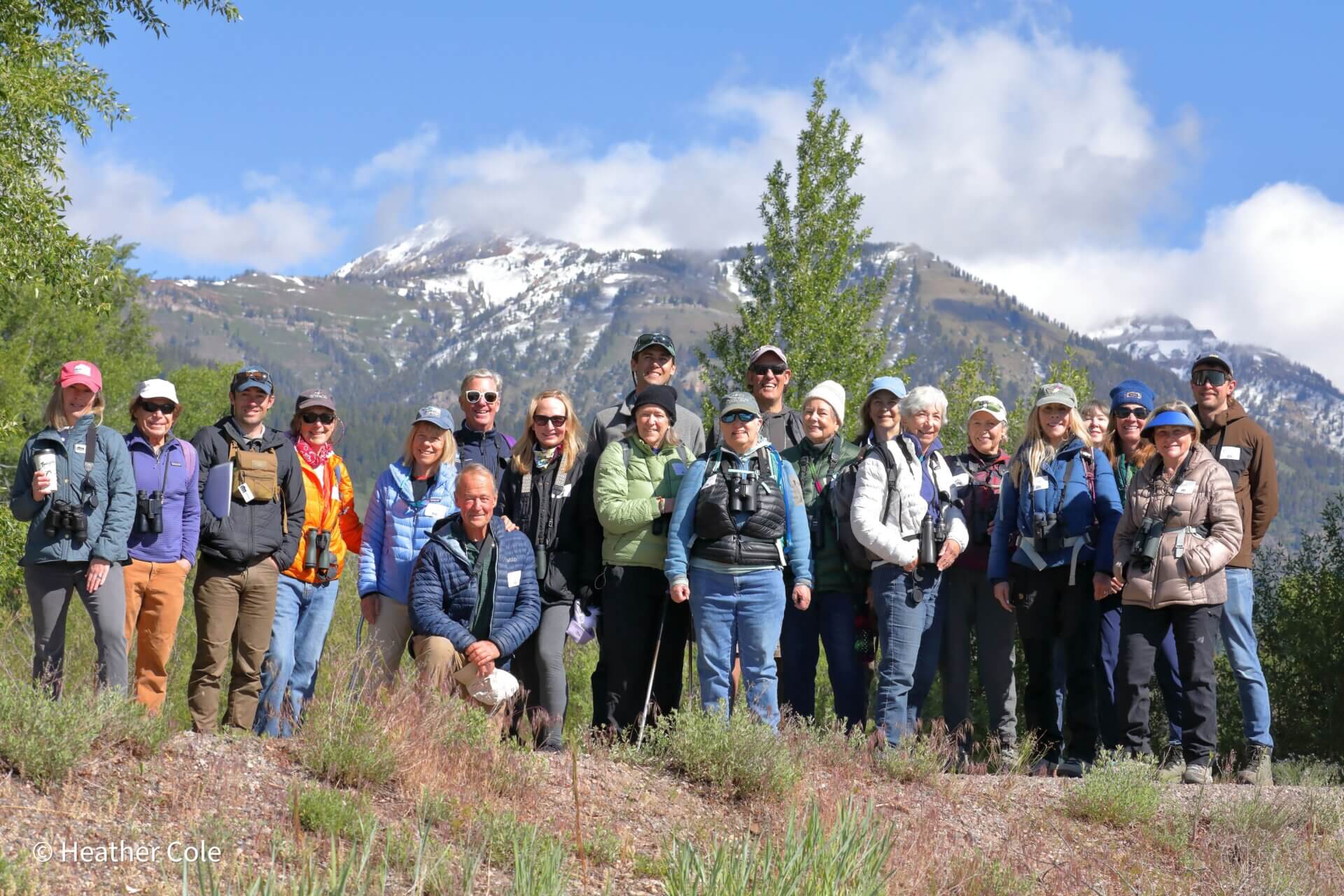
We started close to home. Land Steward and resident birding enthusiast Kyle Kissock led a group through R Park on a morning cold enough for winter hats, and warm enough by the end to forget we’d worn them. More than fifteen species turned up, from belted kingfishers to a western wood-pewee. It was remarkable to have friends who have supported the JHLT for 39 years alongside people who are just learning about our work.
The Carney Easements, Upper Green River
The Carney conservation easements have safeguarded 4,878 acres since 1995, part of a Twin Eagle Ranch property of roughly 15,000 deeded acres. In late June, we floated 8.5 miles through it, starting 18 miles below the Green River Lakes headwaters, with partners from Trout Unlimited and Wyoming Game and Fish, a landowner representative, and a Green River Valley Program advisory council member aboard. We caught a few mountain whitefish and ate lunch on the bank.
Rock Springs
Beneath the ski runs of Jackson Hole Mountain Resort, our Rock Springs conservation easement holds an exposed section of the Teton Fault. Cynthia Blankenship, president of Geologists of Jackson Hole, led us through spruce and wildflowers and unrolled maps in front of it. The Tetons are among the youngest ranges in the Rockies, and the fault is the reason. Cynthia taught us about the fault’s distinctive characteristics and the geological history of the Teton Range, Yellowstone, and Wyoming’s Snake River Valley.
Valley Springs
The JHLT worked with Wyoming Wetlands Society’s (WWS) to protect this parcel as a wild place to help restore trumpeter swan populations. Midsummer, we added a last-minute visit to WWS swan restoration ponds. Program Manager Bill Long walked us through the recovery, which has brought the regional population from just four swans to more than 550. A detail worth carrying home: swans and beavers maintain a commensal relationship. Beavers create wetlands and shallow ponds that swans thrive in, and sometimes swans build nests on top of the lodges.
Munger Mountain
On August 5, we closed the season with naturalist Morgan Graham, GIS and wildlife habitat specialist for the Teton Conservation District, on Munger Mountain’s Forest Service land. Morgan shared his wealth of knowledge, identifying native botany within a rich ecological mosaic of wildflowers, aspen groves, and mountain shrubs, while the group pulled invasive nonnative plants such as musk thistle and knapweed along the way. Then Director of Community Conservation Zach Andres explained the adjacent state parcel: a multi-agency partnership and a 35-year recreational lease from Teton County that will open it to recreation and cattle grazing instead of the large glamping operation once proposed there. It is a working template for how Wyoming might handle its other state parcels.
Five properties, five powerful landscape legacies. Want to explore protected private land for yourself? Mark the second weekend of August 2027 for our new and improved Community Picnic.
Photo: Heather Cole